
Complete Guide to Crude Oil: What It Is, How It's Priced, and Why It Moves the World
Everything you need to know about crude oil — what it is, how it's priced, refined, and why it matters to the global economy.
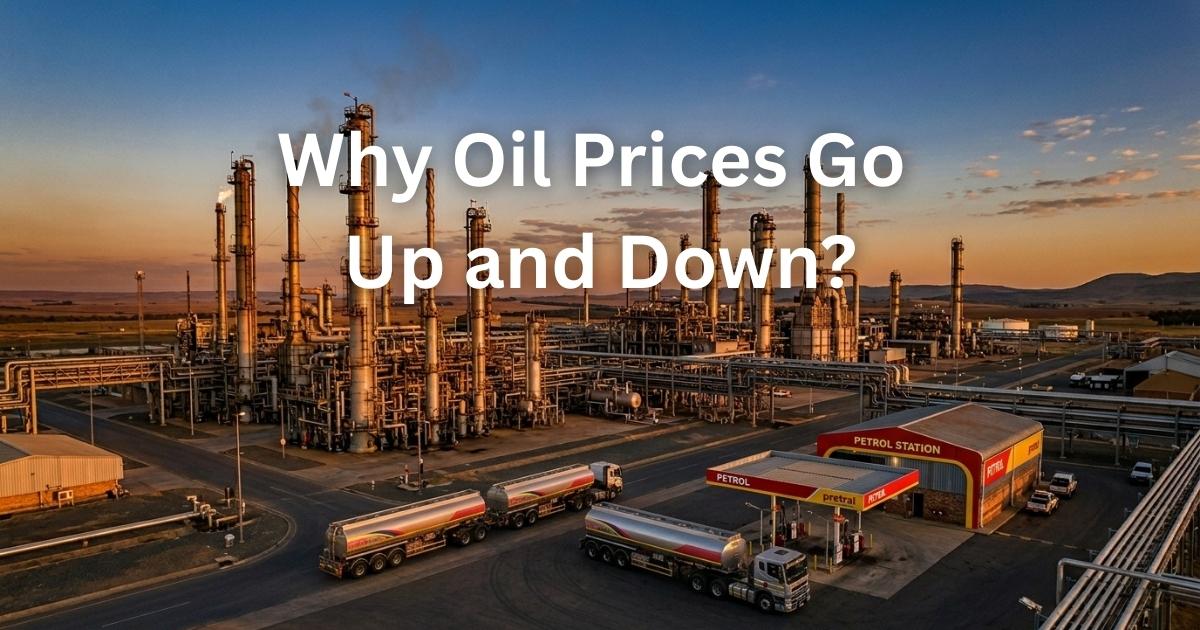
What Determines Oil Prices? Why Oil Prices Go Up and Down
Oil prices can swing 5% in a single afternoon. A production cut announcement from Riyadh, a weaker-than-expected jobs report from Washington, a storm brewing in the Gulf of Mexico — and petrol stations are already updating their forecourt signs.
It looks chaotic. But every move has a reason. And once you know the logic, the daily energy headlines stop being noise and start making sense.
What determines oil prices is the continuous balance between global supply and demand, amplified by geopolitical risk, financial market speculation, and the strength of the US dollar.
The oil price is one of the most consequential numbers in the global economy. It shapes what you pay at the pump, what airlines charge for tickets, what farmers spend on fertiliser, and what entire governments earn in revenue. Understanding what moves it isn't just useful for traders — it matters to anyone who pays bills, buys food, or follows the news.
In this article, you will learn: how oil prices are actually set in global markets, the key supply and demand forces that drive prices up or down, how geopolitics and the US dollar feed into the price, and why oil price shocks ripple through the whole economy.
Key Takeaways
- Oil prices are set in real time through futures contracts traded on global exchanges, not by any single government or organisation.
- Supply is primarily controlled by OPEC+ production decisions and US shale output — both act as powerful levers on the global price.
- Demand is driven by global economic growth, with China playing an outsized role as the world's largest crude oil importer.
- Geopolitical events — wars, sanctions, and infrastructure attacks — can remove millions of barrels from the market overnight and spike prices sharply.
- Because oil is priced in US dollars, currency movements and financial market speculation add a further layer of volatility on top of physical fundamentals.
- A $10 per barrel rise in oil prices adds an estimated 0.3–0.5 percentage points to global inflation, according to the IMF.
Contents
- How Is the Oil Price Actually Set?
- Supply: The Producers Who Control the Tap
- Demand: Who Is Burning All This Oil?
- Geopolitics: When Politics Moves Markets
- The US Dollar and Financial Market Speculation
- Seasonal Patterns and Inventory Data
- Why Oil Price Shocks Hit the Whole Economy
- Frequently Asked Questions
- Conclusion
- Sources
How Is the Oil Price Actually Set?
There is no government office or central bank that decides what a barrel of oil costs each morning. The oil price is set continuously, around the clock, by millions of buyers and sellers trading in global commodity markets.
The mechanism is the futures contract — a financial agreement to buy or sell a fixed quantity of oil at a set price on a future delivery date. These contracts are traded on exchanges like the New York Mercantile Exchange (NYMEX) in the US and the Intercontinental Exchange (ICE) in London. The price you see quoted on the news is simply the current market price of the nearest expiring futures contract.
Who Trades Oil Futures?
The participants range from physical buyers — oil refiners, airlines, shipping companies — to purely financial players like hedge funds and algorithmic trading systems. Many of these financial traders never intend to take physical delivery of a single barrel. They are trading expectations about the future price, which means sentiment, forecasts, and macro data all influence the oil price in real time.
Brent vs WTI: The Two Benchmarks That Set the Global Price
Brent Crude, sourced from the North Sea, is the dominant global benchmark used to price roughly 65% of all internationally traded oil. WTI (West Texas Intermediate), priced at Cushing, Oklahoma, is the primary US benchmark. Both are light sweet crudes and typically trade within a few dollars of each other — but the Brent-WTI spread can widen sharply during regional supply disruptions.
📊 Key Stat: Brent Crude is used as the reference price for approximately 65% of all global oil contracts, making it the single most important price signal in the energy market. For a full comparison of the two benchmarks, see [INTERNAL LINK: Brent vs WTI Explained].
For a complete overview of how crude oil is classified and physically traded around the world, read our [INTERNAL LINK: Complete Guide to Crude Oil].
Supply: The Producers Who Control the Tap
The most direct influence on what determines oil prices is how much crude is flowing into the global market. Too much supply and prices fall. Too little and they rise. Supply is shaped by a small number of extremely powerful players.
OPEC+ and Production Quotas
OPEC+ — the Organisation of the Petroleum Exporting Countries plus allied producers including Russia — collectively controls around 40% of global oil production. The group meets regularly to agree output targets. When OPEC+ cuts production, global supply tightens and prices typically rise. When they increase output, prices can fall sharply.
Saudi Arabia, as the group's de facto leader and the world's largest swing producer, has unique power to move markets. In 2020, a brief price war between Riyadh and Moscow sent Brent Crude below $20 per barrel — its lowest level in nearly two decades. In 2022, coordinated OPEC+ cuts helped push prices back above $90.
To understand how the cartel actually works, see our dedicated guide: [INTERNAL LINK: What Is OPEC?]
US Shale: The Natural Price Ceiling
The US shale revolution permanently altered global oil dynamics. By 2023, the United States was producing approximately 12.9 million barrels per day — more than any other country on earth, according to the EIA. What makes shale unique is its flexibility: producers can bring new wells online relatively quickly when prices are high, adding supply that acts as a natural cap on how far prices can rise.
This dynamic fundamentally limits OPEC+'s pricing power. Every time the cartel cuts to push prices higher, US shale producers benefit from the elevated price and respond by increasing their own output — partially offsetting the cut.
Unplanned Outages and Infrastructure Attacks
Beyond deliberate policy, supply can be disrupted suddenly and without warning. Drone attacks on Saudi Aramco's Abqaiq facility in 2019 knocked out roughly 5% of global supply in a single day, sending Brent up nearly 15%. Libya's ongoing civil conflict has repeatedly removed hundreds of thousands of barrels per day from the market. Extreme weather — a hurricane in the Gulf of Mexico — can shut down offshore platforms and coastal refineries for weeks at a time.
| Supply Factor | Real-World Example | Price Impact |
|---|---|---|
| OPEC+ production cut | Saudi-led cuts in 2022–23 | Pushes prices up |
| OPEC+ output increase | Saudi-Russia price war, March 2020 | Pushes prices down sharply |
| US shale output surge | Permian Basin expansion, 2018–23 | Caps upward price moves |
| Infrastructure attack | Abqaiq drone attack, September 2019 | Sudden sharp spike |
| Sanctions on major producer | Iran 2018; Russia 2022 | Removes supply, raises prices |
| New oilfield coming online | Guyana deepwater fields, 2024 | Adds supply, modest downward pressure |
Demand: Who Is Burning All This Oil?
Supply is only half the equation. The other half is demand — how much oil the world needs and is willing to buy at any given price. Demand is driven by the health of the global economy, industrial activity, transport, and increasingly by the pace of the energy transition.
Global Economic Growth
The single biggest structural driver of oil demand is global GDP growth. When the world economy expands, factories run harder, more goods are shipped, more people fly, and more fuel is consumed. When it contracts, demand falls. The IEA estimated global oil demand averaged approximately 101.7 million barrels per day in 2023 — a record high — driven by robust activity in Asia and a full post-pandemic recovery in aviation.
China: The Demand Variable That Moves Markets
No single country has more influence on the demand side than China. As the world's largest crude oil importer, China brings in roughly 10–11 million barrels per day. Its industrial output, road freight volumes, and petrochemical sector are key drivers of global consumption growth.
When China's economy slows — as it did during the 2022 property sector crisis — demand growth softens and prices come under pressure. When Beijing announces economic stimulus, traders immediately factor in higher Chinese consumption and bid up prices. Watching China's manufacturing PMI has become an essential part of oil market analysis.
💡 Quick Fact: China's crude oil imports of around 10–11 million barrels per day exceed the entire production output of Saudi Arabia. This makes Chinese economic data — factory output, industrial activity, trade figures — some of the most market-moving statistics in global energy trading.
The Energy Transition and Long-Term Demand
Over the longer term, the global shift toward electric vehicles and renewable energy is gradually reshaping the demand outlook. The IEA has projected that global oil demand from road transport could plateau and begin declining in the late 2020s as EV adoption accelerates across China, Europe, and North America. This long-run structural uncertainty keeps producers under pressure to plan for lower price environments. For a forward-looking view, see our [INTERNAL LINK: Oil Price Forecast 2026].
Geopolitics: When Politics Moves Markets
Few commodities are as entangled with global politics as crude oil. The Middle East alone holds over 40% of the world's proven reserves, and any instability there is felt immediately in global prices. The relationship between geopolitics and the oil price is direct, fast, and often disproportionate to the actual physical disruption involved.
Wars, Sanctions, and Export Disruptions
When a major producer is targeted by conflict or sanctions, the market responds even before physical supply is affected. Western sanctions on Iran from 2018 removed an estimated 1.5–2 million barrels per day from global supply. The 2022 invasion of Ukraine triggered one of the most significant geopolitical supply shocks in decades, forcing the rerouting of Russian crude flows and creating extreme volatility in European energy markets.
The Geopolitical Risk Premium
Even the threat of conflict adds a geopolitical risk premium to the oil price — an extra amount per barrel that traders are willing to pay to compensate for the possibility that supply could be disrupted. This premium can be larger or smaller than the actual risk justifies, but it is a permanent feature of oil pricing whenever tensions rise in key producing regions.
For a historical perspective on how geopolitical events have driven the oil price over 50 years, explore our [INTERNAL LINK: Oil Price History 1970–2026].
The US Dollar and Financial Market Speculation
Crude oil is bought and sold globally in US dollars. This creates a direct link between the dollar's value and the oil price. When the dollar strengthens, a barrel of oil becomes more expensive for buyers using euros, yen, or rupees — which can suppress international demand and weigh on prices. When the dollar weakens, oil becomes relatively cheaper for global buyers, tending to support consumption and push prices higher.
Interest Rates and the Dollar-Oil Link
The US Federal Reserve's interest rate decisions feed directly into oil prices through the dollar. When the Fed raises rates aggressively — as it did through 2022–23 — the dollar typically strengthens, creating headwinds for oil. When rates fall or are expected to fall, the dollar weakens and oil often benefits. This is why energy traders watch every Fed meeting and US inflation print almost as closely as OPEC announcements.
Speculation and Market Sentiment
Beyond the physical market, financial speculation plays a major role in short-term price volatility. Hedge funds, investment banks, and algorithmic trading systems trade enormous volumes of oil futures daily — volumes that far exceed the physical market itself. Expectations about the future — economic forecasts, geopolitical outlooks, inventory projections — can move prices well before any real-world change in supply or demand occurs.
A single disappointing Chinese manufacturing PMI, a hawkish Fed signal, or a surprise inventory build can trigger a wave of automated selling across oil futures, pushing the price down $2–3 per barrel in minutes. This financial amplification layer is a key reason the oil price is more volatile than most other commodities. For more on how futures markets work in practice, see our [INTERNAL LINK: Complete Guide to Oil Prices].
Seasonal Patterns and Inventory Data
On top of the big structural forces, oil prices also move in predictable seasonal rhythms — and react sharply to weekly data releases that give the market a real-time read on supply and demand balance.
Seasonal Demand Cycles
Demand for petrol peaks in the northern hemisphere summer — the US driving season from Memorial Day in late May through Labor Day in early September produces a reliable uplift in fuel consumption. Heating oil demand surges in winter across the US and Europe. Jet fuel demand rises through summer and over major holiday periods. Traders price these seasonal patterns into futures contracts months in advance.
The EIA Weekly Inventory Report
Every Wednesday at 10:30am EST, the US Energy Information Administration publishes its Weekly Petroleum Status Report — detailing how much crude oil, petrol, and distillates are sitting in American storage tanks. It is one of the most market-moving weekly data releases in global commodities.
When inventories rise more than expected, it signals supply is outpacing demand — bearish for prices. When inventories fall sharply (a "draw"), it signals tight supply or strong demand — bullish. A significant surprise in either direction can shift Brent Crude by $1–2 per barrel within seconds of the release.
📊 Key Stat: The EIA's Cushing, Oklahoma storage hub has a working capacity of approximately 76 million barrels. When Cushing fills up — as it nearly did in April 2020 — it can cause extreme and unusual price dislocations, including the brief period when WTI futures traded at negative prices.
Why Oil Price Shocks Hit the Whole Economy
Understanding what determines oil prices matters not just for traders and investors — it matters because oil price shocks cascade through the entire global economy within weeks. Oil is embedded in almost every supply chain on the planet, which means that when its price spikes, those extra costs spread rapidly and widely.
Transport costs rise immediately, pushing up the price of almost everything that needs to be moved — which is nearly everything we buy. Airlines raise ticket prices. Farmers face higher bills for tractor fuel and for fertilisers, which are derived from petrochemicals. Manufacturing costs increase. Governments in oil-importing nations see their trade deficits widen and their currencies come under pressure.
The IMF has estimated that a sustained $10 per barrel rise in oil prices adds approximately 0.3–0.5 percentage points to global inflation. In a stable environment that may be manageable. But when central banks are already fighting elevated inflation, an oil spike can tip the balance toward further rate hikes — slowing growth and tightening financial conditions for households and businesses alike.
The reverse is equally damaging, just for different countries. When oil prices crash — as they did in 2015–16 and catastrophically in 2020 — oil-exporting nations suffer severe economic strain. Saudi Arabia, Russia, Iraq, and Nigeria all depend on crude revenues to fund public budgets. Prolonged low prices force spending cuts, currency devaluations, and political instability in these economies.
For a full breakdown of how the oil price feeds into the cost of living, read our dedicated explainer: [INTERNAL LINK: Why Oil Prices Affect Inflation]. For the full picture of who produces the most, visit our [INTERNAL LINK: Largest Oil Producers in the World].
Frequently Asked Questions
What is the single biggest factor that determines oil prices?
The fundamental driver is the balance between global supply and demand. Over the long term, economic growth — especially in China and other large emerging markets — drives the demand trends that set the floor under prices. In the short term, OPEC+ production decisions and geopolitical disruptions often have the most immediate impact. Financial market speculation amplifies these moves in both directions, making short-term price swings larger than physical fundamentals alone would justify.
Why do oil prices rise when there is conflict in the Middle East?
The Middle East holds over 40% of the world's proven oil reserves and is home to several of the largest producers. Conflict in the region raises the risk that supply could be disrupted — so traders immediately factor in a geopolitical risk premium. Even if physical supply is unaffected in the short term, the market responds to uncertainty. This premium can persist for weeks or months even if the feared disruption never fully materialises.
Why did oil prices go negative in April 2020?
In April 2020, WTI crude briefly traded at negative prices — meaning sellers were paying buyers to take oil off their hands. COVID-19 lockdowns had collapsed demand almost overnight, while US storage tanks at Cushing, Oklahoma, were approaching full capacity. Traders holding expiring futures contracts faced the prospect of taking physical delivery of oil they had nowhere to store. To offload those contracts at any cost, they accepted negative prices. It was a structurally extreme event illustrating what happens when supply and demand become severely dislocated simultaneously.
How does OPEC actually control oil prices?
OPEC+ controls prices by coordinating production quotas among its members. When the group agrees to reduce output, less oil enters the global market — assuming stable demand, prices rise. When it increases output, prices come under pressure. The cartel's power is real but not unlimited: it depends on member compliance with agreed quotas, which is inconsistent, and it is increasingly constrained by US shale producers who ramp up output whenever prices rise to profitable levels. For a full explanation, see our [INTERNAL LINK: What Is OPEC?] guide.
Does a weaker US dollar always push oil prices higher?
Generally yes — but the relationship is not mechanical. Because oil is priced in US dollars, a weaker dollar makes crude cheaper for buyers holding other currencies, supporting demand and pushing prices higher. A stronger dollar works in reverse. However, the relationship can break down when other forces dominate. A severe global recession, for example, can collapse oil demand so dramatically that prices fall even as the dollar weakens. The dollar-oil link is a reliable directional tendency, not a guaranteed rule.
Conclusion
The oil price is not controlled by any single actor — it emerges from the constant, simultaneous interaction of supply, demand, geopolitics, and financial markets. Understanding how these forces work together — and how to read the signals they send — is one of the most practically useful skills for anyone following global economics or energy markets.
- Supply is dominated by OPEC+ production decisions and US shale output, with sudden disruptions from geopolitical events and extreme weather creating sharp short-term shocks.
- Demand is driven by global GDP growth and industrial activity — especially in China — and faces long-term structural pressure from the accelerating energy transition.
- Financial markets and the US dollar amplify every move: speculation, sentiment, and currency fluctuations sit on top of physical fundamentals and account for much of oil's day-to-day volatility.
Read next: [INTERNAL LINK: Complete Guide to Oil Prices] — learn exactly how oil futures work, what the Brent-WTI spread signals, and how to track prices in real time.
Sources
- U.S. Energy Information Administration (EIA) — Short-Term Energy Outlook and Weekly Petroleum Status Report
- International Energy Agency (IEA) — Oil Market Report 2025
- OPEC Annual Statistical Bulletin — Member production, reserves, and market share data
- International Monetary Fund (IMF) — World Economic Outlook: Oil price impacts on global inflation
- ICE (Intercontinental Exchange) — Brent Crude Futures contract specifications
- CME Group / NYMEX — WTI Light Sweet Crude Oil Futures